Insights &
Company News.
Stay up to date with the latest from Allied ESM: industry insights, product updates, partnership announcements, and thought leadership from our team of ESM experts.
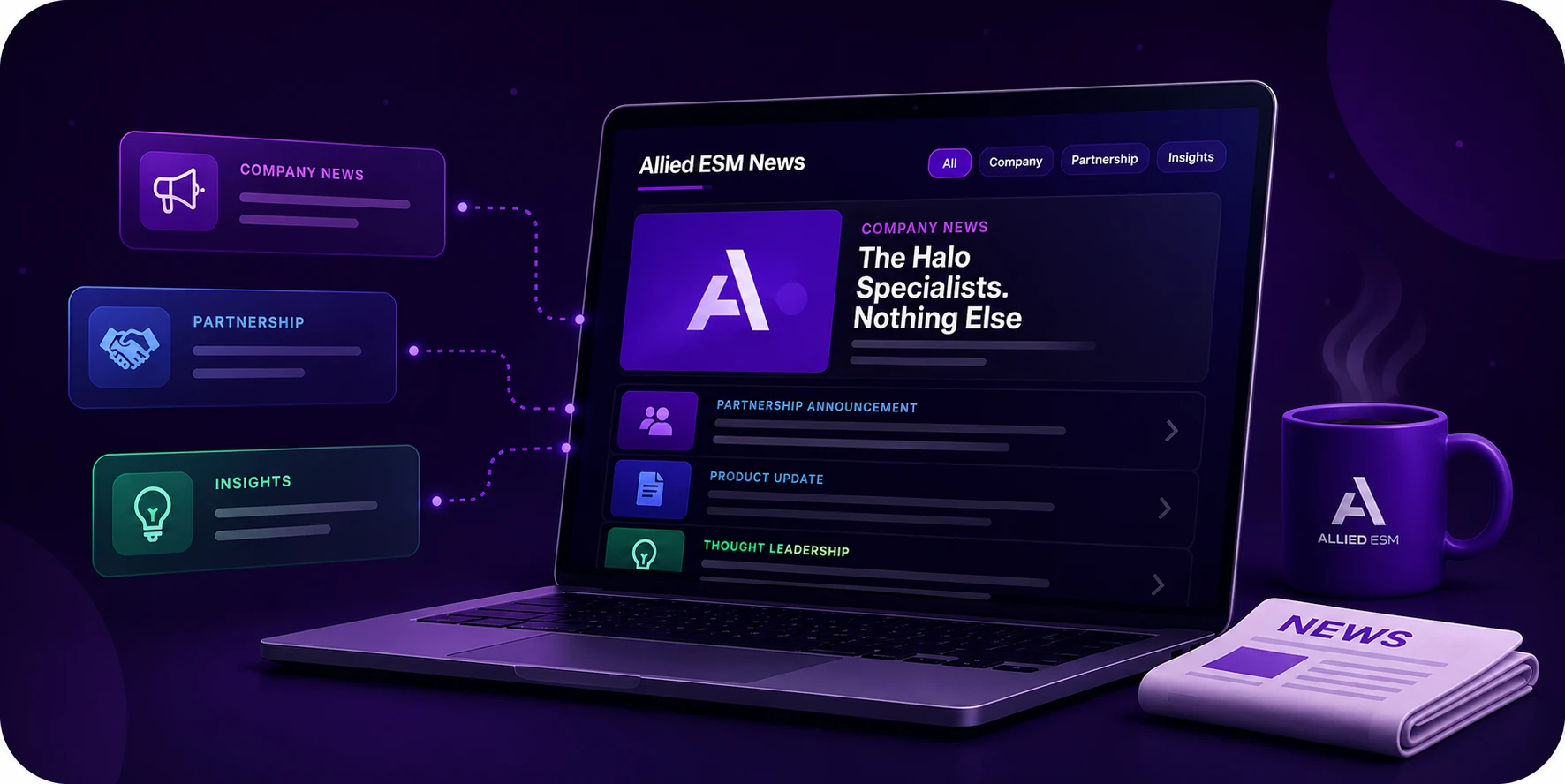
What's Happening at Allied ESM
News, insights, and updates from our team. More content coming soon.
Try adjusting your search or filters.
Halo Is Moving to AWS EKS: What Changes, and What Your IT Team Needs to Do
Halo is moving to Kubernetes on AWS, reaching Stable in Q1 2027. It brings faster scaling and load times, plus new IP ranges, certificate DNS records and a User-Agent rule for your IT team.
Halo's 2026 Final Release: What's New, and What Actually Matters
Halo's last release of 2026 brings CMDB reconciliation, workflows on CIs, automatic PII redaction and a Zoom app. Here's what genuinely matters for how you run a service desk.
Allied ESM Now Covers Halo ITSM, CRM and PSA
Halo is an enterprise service management platform, and Allied ESM now implements across all of it: ITSM for IT teams, CRM for sales teams and PSA for managed service providers. The same platform runs HR, facilities and finance requests too, all on one Halo licence with no tiers or bolt-ons. One partner who can scope the whole platform, rather than one supplier per product.
Allied ESM Achieves Cyber Essentials Certification
Allied ESM has been certified against the UK Government-backed Cyber Essentials scheme, with a scope covering the whole organisation rather than a single system or team. It verifies the five technical controls that defend against the most common internet-based attacks, and can be checked independently on the IASME registry.
Halo Named a Challenger in the 2026 Gartner ITSM Magic Quadrant
Gartner has reintroduced its Magic Quadrant for IT Service Management Platforms, published 27 July 2026. Halo is named a Challenger — independent recognition in a market that reached nearly $9 billion in 2025.
HaloITSM 2026.2: What's New, and What Actually Matters
Halo's second 2026 release lands AI Agents and Abilities inside runbooks, parallel approvals with risk-based routing, and tighter access control. Here's what genuinely matters for how you run a service desk.
Getting the Most from Halo Starts with Getting the Scope Right
Halo works well at every level — from a fast service desk deployment to a fully automated, service-aware platform. The key is knowing which one your organisation needs before the project begins.
Why ITSM Projects Fail Before They Go Live
Most ITSM implementations that struggle do not fail at go-live — they fail earlier, through stakeholder dynamics that are largely predictable and almost never addressed until the damage is done. Five patterns, explained.
Building the Business Case for Halo ITSM — and Proving It Delivered
The technical evaluation is the easy part. Here is how to build the internal case that secures approval, earns genuine commitment across finance, operations and IT — and then proves the investment actually delivered.
Halo AI Strategy 2026: Agents, Blueprint, and Machine Learning
Halo shared its AI roadmap for 2026 across three pillars: platform intelligence with unsupervised ML, embedded agents with human-in-the-loop approvals, and headless MCP integration. All of it in the existing licence.
ServiceNow's Legacy SKU Sunset: What to Do Now
ServiceNow's April 2026 restructure retired Standard and Professional SKUs and moved Change, Problem and Major Incident Management to the Advanced tier. Here is what you need to check before your next renewal, and what Halo offers as a simpler alternative.
ServiceNow's April 2026 AI Pricing Tiers Explained
ServiceNow has folded AI into every SKU across new Foundation, Advanced and Prime tiers, but it is still metered by token pools and the pricing was not disclosed. Here is what it means at renewal, and how Halo compares.
Halo $1M Forever: Fixed-Price Enterprise ESM Locked for Life
Halo's $1M Forever programme fixes enterprise ESM pricing at $1M ACV permanently. No increases, no upsells, with an Innovation Grant covering migration costs. Here is what it means for large organisations.
Halo ITSM and the SDI Global Best Practice Standard
The SDI Global Best Practice Standard V9 adds a dedicated AI governance concept. Here is how Halo maps across all ten concepts — including the new Managing the AI System requirement.
HaloSphere 2026: What to Expect on 11 June
HaloSphere returns on 11 June at 133 Houndsditch, London. Four session tracks covering Halo AI, ITSM, ESM, and CMDB. Here is what is on the agenda and what to prioritise on the day.
Why Your Halo AI Business Case Is Probably Wrong — and What to Measure Instead
The standard AI business case is built on headcount reduction. It's almost always the wrong starting point. Here's why that framing will fail your Halo AI deployment — and the quality KPIs that actually tell the story.
Halo Achieves FedRAMP 20x Moderate Authorization
Halo is now FedRAMP Certified at Class C Moderate under the new 20x standard, making it one of the first platforms globally to reach this milestone. Here is what it means for US government customers.
Virima Discovery Readiness Checklist — Is Your Environment Ready?
Before Allied ESM begins a Virima Discovery implementation, the environment needs to be ready. This free pre-deployment checklist walks IT and infrastructure teams through server requirements, firewall rules, credentials by asset type, and cloud prerequisites for AWS and Azure — everything to confirm before kickoff so you can go from discovery to live scans in days, not weeks.
ITSM in 2026: What the Analysts Are Really Saying
Gartner, Forrester, and independent market research all point in the same direction. The ITSM market is growing fast — from $13.5B today to an estimated $30B by 2030. AI is delivering real results, but specifically in ITSM, not across the broader I&O landscape. And ServiceNow's total cost of ownership is under serious scrutiny, with alternatives now offering 30–70% cost savings. We've pulled together the key numbers to help organisations understand where the market stands.
The Golden Rules of Service Modelling in Halo ITSM
After working through dozens of Halo SAF implementations, the most common failure pattern isn't technical — it's scope. Organisations either model too much (every asset, every dependency, whether it matters or not) or too little (a few vague services with no ownership data attached). The golden rules exist to stop both. Before you define a single service, you need to understand the ecosystem around it: who provides and supports it, who owns and governs it, and who actually requests it. Then you model only what's necessary — what has an owner, what supports an ITSM process, and what delivers a tangible business outcome. The two questions that cut through almost every modelling debate are these: does this service need ITSM support, and would it survive a modelling review in six months? If the answer to either is no, leave it out. A lean, well-governed SDM outperforms a bloated one every time.
Service Catalogue vs Request Catalogue — What's the Difference?
This is one of the most common points of confusion in a Halo implementation, and it causes real problems if it isn't resolved early. The Service Catalogue is your CMDB — it holds the five-layer SDM hierarchy and drives all automation. The Request Catalogue is what your end users see in the self-service portal. They aren't the same thing, and conflating them leads to either a portal full of internal IT plumbing that confuses users, or a CMDB built around what looks good in the portal rather than what actually drives routing. The key mechanism to understand is the twin: when you create a Technical Service in the CMDB, Halo automatically creates a corresponding catalogue item in the portal, hidden from end users by default. You choose when and to whom each item is visible. This means your SDM build directly populates your request portal — no duplication of effort, no second system to maintain. The discipline is keeping each catalogue doing its proper job.
How Halo Routes Tickets Automatically — The SAF Routing Rules Explained
One of the most tangible payoffs of implementing the Service Data Model is that Halo can route tickets without anyone making a manual decision. When a ticket is created, Halo evaluates a cascade of rules to find the right Technical Service and apply its TOM data — assignment team, SLA, escalation path. The logic is sequential: if the ticket form has dedicated routing, use it. If the primary CI is a Business Application Instance with no direct TOM, fall back to the owning Business Application. If that has no TOM either, use the owning Technical Service. The cascade means that even an incomplete SDM delivers value — you don't have to finish the full model before automation starts working. What this means practically is that the moment you populate TOM data on a Technical Service, every incident raised against a CI owned by that service gets routed automatically. No routing rules to configure, no team lists to maintain separately. The model does the work.
Halo Launches ARR Milestones — We Grow, You Save
This is exactly the kind of announcement that reminds us why we chose to partner with Halo. ARR Milestones is an industry-first pricing programme where Halo's own growth translates directly into licence discounts for every customer on standard pricing. It launches now at approximately £100 million ARR with a 5% reduction, compounding by a further 5% at each milestone — £250M, £500M, £750M, and £1 billion. No price increases. No opaque renewals. Just a published ladder of savings you can actually plan around. It's possible because Halo operates differently: privately owned, product-led, and without the shareholder pressures or inflated overheads that quietly drive up costs at the big enterprise vendors. We've built Allied ESM on the belief that better ITSM doesn't have to cost more. Halo just made that official.
Allied ESM Comes Out of Stealth
After months of quietly building behind the scenes, Allied ESM officially launched in February 2026. We're a pure-play Halo partner, built by people who spent over a decade in the ServiceNow ecosystem and made a deliberate choice to back a better platform. Our mission is straightforward: help organisations realise the real advantages of Halo ITSM — highly configurable, fast to deploy, and at a fraction of the total cost of traditional enterprise vendors. Deep service management expertise, without the overhead or the price tag that usually comes with it.
Allied ESM Partners with Virima to Solve the CMDB Problem
Good ITSM starts with accurate data, and that's exactly why we've partnered with Virima. The CMDB problem is one of the most common barriers to getting real value from your Halo platform — stale data, manual maintenance, and configuration items you simply can't trust. Virima's continuous discovery and automated service mapping integrates natively with Halo ITSM, keeping your CMDB accurate without manual effort. Together, we're helping organisations resolve incidents faster, make safer change decisions, and finally trust the data that drives their service operations.
Virima Achieves ISO/IEC 27001:2022 Certification
For any organisation considering Virima as part of their Halo stack, this matters. Virima has achieved ISO/IEC 27001:2022 certification — the world's leading standard for Information Security Management Systems — with zero non-conformities identified in the audit. Your CMDB holds some of the most sensitive data in your entire IT environment: every system, asset, and dependency across your infrastructure. Knowing the platform managing that data operates to internationally recognised security standards is significant, particularly in regulated industries. Combined with Virima's existing SOC 2 Type 2 certification, it's a compliance story that removes risk from the conversation entirely. Another reason we're proud to bring Virima and Halo together for our clients.
What's New in Halo ITSM — Q4 2025
Halo's Q4 2025 release is a strong one. AI-powered translation for the Self-Service Portal removes language barriers for global deployments, while AI-generated analysis can now be embedded directly into scheduled PDF reports — cutting the time your teams spend interpreting data. The portal can now be installed as a Progressive Web App, giving users a native app experience without any development effort. Dynamic Search Profiles bring shareable, URL-driven ticket filters with real-time SLA breach visibility built in. Dashboard grouping with tabbed navigation makes managing multiple dashboards far more intuitive. Two new integrations — SailPoint IIQ and Google Maps — round out a release that continues to push Halo's capabilities forward. Fifteen new features in a single quarter.
CDP Goes Live on Halo ITSM — Q1 2026
We're proud to share that CDP, the world's environmental disclosure system, went live on Halo ITSM in Q1 2026. Allied ESM delivered a full implementation in under three months — replacing TopDesk, migrating three years of historical service data, and deploying a multi-department self-service portal. CDP now has structured workflows, real-time KPI dashboards, and full internal ownership of the platform. A non-profit organisation. A global mission. And a modern ITSM platform to match.
Sidney Sussex College Modernises IT Service Delivery — Q1 2026
Sidney Sussex College went live on Halo ITSM in Q1 2026, replacing a legacy osTicket setup with a structured, modern service management platform. Allied ESM delivered the implementation — bringing structured incident management, a self-service portal, and the operational foundations the College's IT team needed to manage and grow the platform independently. A great result for the team and the wider university community they serve.
Brick Court Chambers Launches Halo ITSM in Five Weeks — Q1 2026
Brick Court Chambers, one of the UK's leading barristers' chambers, went live on Halo ITSM in January 2026 — just five weeks after kick-off. Allied ESM delivered a clean, rapid implementation built almost entirely on out-of-the-box functionality, giving the team structured incident management and a clear operational foundation without unnecessary complexity. Fast, focused, and exactly what the organisation needed. Zero custom code. Fully operational in a month.
Halo On-Prem: The Full Power of Halo on Your Infrastructure
Most Halo customers run on Halo's cloud infrastructure — but for organisations with data residency requirements, regulatory constraints, or a preference for self-hosted software, Halo supports full on-premises deployment. This guide covers the infrastructure requirements, deployment model, how patching and upgrades work, and what's different from the cloud-hosted version. If your organisation is evaluating Halo and on-prem is a consideration, this is the right starting point.
Change & Adoption Readiness Checklist
Up to 70% of IT transformations fail not because of the technology, but because people don't adopt it. This readiness checklist helps you assess whether your organisation is prepared for change before go-live — covering leadership sponsorship, stakeholder communication, champion networks, training plans, and hypercare. Designed for programme leads, project managers, and IT leaders responsible for a successful Halo ITSM rollout.
Halo Licensing: Named & Concurrent — A Guide to Flexible ESM Licensing
Halo offers named and concurrent licensing — and choosing the right model depends on how your teams actually use the platform. This guide explains the difference, when each applies, and how organisations with mixed user types (full-time IT staff, shift workers, occasional users) can structure their licences to minimise cost without limiting access. It also sets Halo's single all-inclusive licence against the per-module pricing of ServiceNow and Freshservice.
Training & Self-Sufficiency: The Halo Approach to Lasting Capability
Halo University provides free, structured training for every Halo customer — Foundation, Administrator, and Architect levels, included in the licence. This guide explains how Allied ESM uses Halo University alongside hands-on implementation to build client-side capability from day one. The goal is self-sufficiency: by go-live, your team should be able to configure, extend, and maintain Halo without relying on external consultants for every change.
Under the Hood: How Halo Is Built
Halo runs on a modern cloud-native stack — hosted on AWS, with a React frontend, SQL Server data layer, and a REST API that underpins its 250+ native integrations. This technical reference covers the platform architecture, hosting model, security certifications (ISO 27001, SOC 2, PCI DSS), performance benchmarks, and how Halo handles multi-tenancy and concurrent load. Designed for IT architects and technical evaluators who need to understand the platform before signing off on it.
Get the Latest from Allied ESM
Industry insights, case study spotlights, and company updates — direct from the team. We'd love to hear from you too.
Seen enough? Let’s talk.
Whether you're exploring Halo ITSM for the first time or looking to optimise an existing platform, our team is ready to help.